
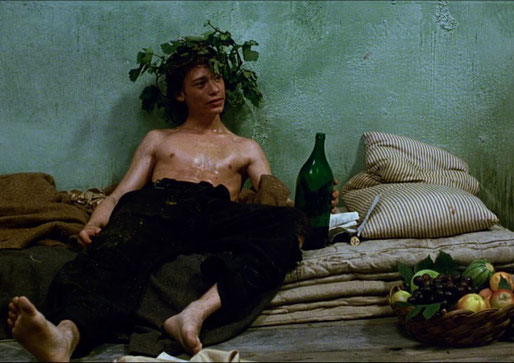
Dexter Fletcher as Caravaggio the young man. The film is jam-packed with these sorts of stunning images.
What is it?
A 1986 film by English director Derek Jarman.
And it’s about Caravaggio the Italian painter, I assume?
You would be correct. Being a Derek Jarman film, it’s not a traditional biopic. The story is told out of order, with anachronistic costuming and props (there’s a typewriter, for instance), and the tale is not necessarily imparted in a way that makes it easy to follow.
Did you glean enough to provide something like a summary?
Well, the film begins with Caravaggio on his deathbed, tended by his ever-loyal servant Jerusaleme. Then we go back in time, we learn how Jerusaleme was sold to Caravaggio, and we enjoy some scenes of the saucy young painter (played by an angelically lovely Dexter Fletcher). And then he comes into a period where he is an established artist, enjoying the patronage of a cardinal. He falls for a tough young guy (the gorgeous Sean Bean), has a complicated relationship with him and his girlfriend (the gorgeous Tilda Swinton), both of whom Caravaggio uses as models. Things end badly.
That sounds highly dramatic. Melodramatic, even.
Yes, but Jarman doesn’t really tell the story in a way that makes it suspenseful or exciting. He’s more interested in beautiful imagery, I find. And the film is very beautiful, the whole thing looks like a Baroque painting. It’s exquisite. Jarman was a visual artist himself, and he clearly understands how artists work.
Despite the praise, I’m sensing a lack of exuberance in your reaction to this film.
I’d like to be able to say I actually enjoy Jarman’s films, that I love them. But I do find them lifeless. And I find myself covering my eyes in apprehension of the inevitable scenes of violence and blood. All of his films are worth seeing, and certainly this one is populated with a whole series of gorgeous men (including the adult Caravaggio himself, played by Nigel Terry) and lots of breathtaking homoerotic imagery. I guess, at the end, I just don’t know what to make of it all. I don’t feel much of anything, watching this film, apart from a kind of clinical admiration of how visually stunning it is.
Stars?
I’m tempted to give it a star because it’s an important queer film (important because it’s intelligent and original and well acted), and if you like Jarman’s films, this is by most accounts one of the best. But I found it less compelling than either Sebastiane (with its portrayal of an enduring gay icon) or Blue (the hauntingly autobiographical film about Jarman’s battle with AIDS), so I’m going to refrain from giving this one a star, in an attempt to hold on to the star’s value.
Write a comment