
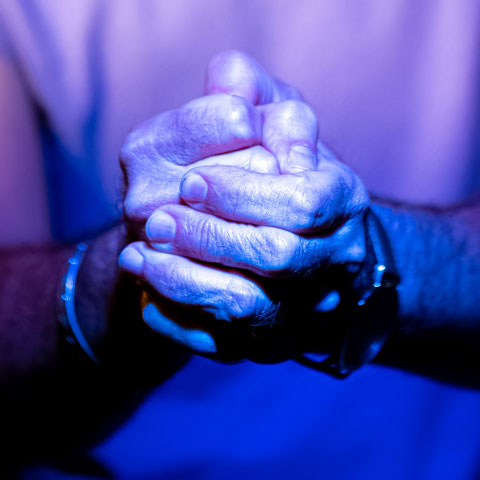
My hands, in Prague in 2023.
Photo credit: Lux Praguensis
AI.
Suddenly, it seems, this has moved from being a fringe topic for geeks to THE hot issue, the next big wave that’s going to overwhelm us and transform all our lives whether we like it or not.
Do I have any thoughts about it?
Well, yes. I live in the world.
Where to begin?
I was born in 1962. I grew up and lived my early adulthood in the era of land lines, letters in the mail, and TV shows that you had watch when they were “on.” And yes, I will admit to a healthy dose of nostalgia when I think of those times, much of it likely influenced by the nostalgia many of us feel when we think of our younger, hopefully more carefree days, whenever those were.
Honestly, though, when I look at what has happened over the past thirty years, the way technology has pervaded our lives, I have a hard time seeing it as progress. I’m trying to be fair here. The technology has undoubtedly opened up breathtakingly efficient opportunities to simplify our lives (I absolutely adore the app that lets me easily access the publicly available bicycles in Montreal). But there is a lot of empirical evidence that is undeniable, and that is now recognized by academics and governments worldwide: a younger generation that shows alarming levels of depression and anxiety, the obliteration of the distinction between truth and falsehood that has led to the extreme politics we see in so many countries now, the international epidemic of solitude, the hollowing out of anything resembling communal life in favour of atomized individuals walking the streets staring at phones reflecting their "truth" back at them.
It’s all happened so quickly!
I’m old enough to remember the optimism of so many in the 1990s, the belief that the internet was going to usher in a fabulous new world. (Thirty years on, look around. Is our world doing so well?) I recall the excitement when social media began to emerge in the 2000s and 2010s: we were entering an age when we’d all be one big happy planet talking to one another and solving problems together. (Has that happened?)
Now we’re told that AI is the answer. I have noticed that there is distinctly less optimism this time round, so maybe we are learning something from experience. In its place is a weary resignation, expressed by some version of “It’s happening anyway, the genie is out of the bottle, it’s going to take all our jobs, so we have to prepare. It’s the future.” (If only we took this view about climate change, which actually is out of the bottle and happening anyway.)
Do we no longer have any individual command over our own lives? Can we not sometimes just say No?
Who’s pushing this? Why? Are they making billions from it?
As it happens, I’m currently reading Viktor Frankl’s Man’s Search for Meaning. Whilst imprisoned at Auschwitz and toiling away on a work detail, Frankl found himself thinking one day about his wife (she was also imprisoned, but he couldn’t see her and didn’t know if she was still alive). Suddenly, he was overwhelmed with the truth that so many great thinkers and philosophers and saints have expressed since time immemorial: that the only thing that matters, the only enduring meaning in life, is Love. When everything else is gone, as it was for Frankl at that moment, when there’s nothing left to lose, what remains? Love. Even the memory of Love.
Putting that in its 2026 context, I’d say Love manifests itself every time you put your phone down and look someone in the eye and relate to them.
Love manifests itself when you turn away from technology to go for a walk and feel connected to the natural world of which you are a part.
Love manifests when you glance up from your screen to acknowledge the presence of another human being sitting down opposite you on the bus.
Love is present when you choose to go out and buy a book in a human-staffed, bricks-and-mortar store rather than ordering it online for delivery by someone who will ring the bell, chuck the thing inside, and disappear.
AI is the antithesis of all this. AI represents the evacuation of the human element, of Love.
A man who has nothing left in this world
still may know bliss, be it only for a brief moment,
in the contemplation of his beloved.
---Viktor E. Frankl
I keep hearing people say that AI is going to “replace” us, since it can do everything we do. If that is your sense of the value of human life—that it is meaningless apart from its utility—that’s an utterly terrifying philosophy you’re living with. I have hesitated to make the connection with fascist Germany, but Viktor Frankl did it for me, in his 1984 postscript to Man's Search for Meaning: "If one ... holds that an individual's value stems only from his present usefulness, then, believe me, one owes it only to personal inconsistency not to plead for euthanasia along the lines of Hitler's program ..." (Speaking of which, remember those who said that COVID was an opportunity to wipe out the weak?)
Everything of value in our lives is about human beings and our capacity for joy. When someone gives you a present, the value is not in the price tag attached to the object. The value lies in the Love the gift represents, that fact that someone thought about you and took the time to choose something for you (or make something for you) and give it to you. It’s pleasant to imagine that person going out to the shop to pick up that thing to give you; it’s pleasant to think about because you love them, and you love to think of them filled with joy at the prospect of making you, in turn, happy. That is what human life is about. Such interactions are where we derive meaning, what will give us strength to draw upon in tough times.
If someday an algorithm figures out what “thing” you’d like for your birthday—the thing that would make you most happy according to your recent online activity—and arranges for it to be delivered by a drone, that ain’t going to have much meaning for you, my friend. That AI data centre and that drone didn’t take any pleasure in doing this for you. (On the other hand, someone did make some money, which—sadly—is still the way our culture attaches value to anything, even as our late-capitalist society goes down the drain.)
It’s not the thing, the content, the product, the efficiency that matters in life. It’s all about the Love.
* * *
As someone who writes and performs, I’m particularly interested in the developing notion that AI is going to replace human artistic creation. I must say, even before all the recent talk about AI, I was already noticing how so much creative activity has been reduced to “content creation” (or my own term, “cultural product”), devoid of meaning apart from its contribution to the GDP. We are voluntarily dehumanizing ourselves when we create and consume “art” like a commercial product, rather than reacting to it viscerally and letting it have an influence on us (which is what real art is about). “Cultural production” has now reached such a phase of sophistication that TV series and movies and books and music get released at a crazy rate. Most industrially generated entertainment is pretty good (at least technically), it passes the time, but it’s also all a bit the same, and ultimately it’s just so much product to be consumed and create shareholder value and employment for the “cultural sector.”
Rather than “binge-watching” hours of Netflix content (why do so many people think this is a cool thing to do?), how about tearing yourself away from the screen and going to hear some live music? Or maybe go to a theatre festival, see a couple of shows, and let yourself be moved by them? And the more small-scale these events are, the more removed they are from the capitalist nexus, the more likely you are to be able to chat with the artist afterwards, should you wish. (Okay, I admit, I write and perform at small, volunteer-led theatre festivals, and I think they’re important.)
Reacting to what another human being is doing, whether it’s performing on a stage in front of you or licking the back of your neck—this is called human connection. (And I really believe it’s something the developers and proponents of AI just don’t “get.”)
Without that connection, what you have is empty production, whether it comes from human beings or from AI. So yeah, AI might generate beautiful images or things. But why? What inspired them? You’ll never be able to discuss that with them/it over a beer.
As I said, it’s not about the amount, or even really the quality, of production. It’s about the human being behind it, and their capacity for joy. Their Love. The Love they felt when they were creating it. The Love you show when you open yourself up to being moved by it.
So, in reponse to AI, all I can say is: Let’s give Love a try again! Give me an imperfect thing created by a human being who wasn’t looking to make money. (And, while we’re talking about money, if AI is going to take all the jobs, how about a basic guaranteed income for everyone? People are important. I’m not sure the tech boys get this either.)
Over time, capitalism has had the effect of removing meaning from everything. AI is just the last step in that long process. So now we can begin our search for meaning again. But we’re not the first human beings who have ever lived. Others have pointed to the true sources of meaning and joy and peace over the millennia. It’s time to get back to some basics. We're always free to put down the phone or turn away from the screen and choose to love. It's a revolutionary act! And a beautifully human one.
Write a comment