
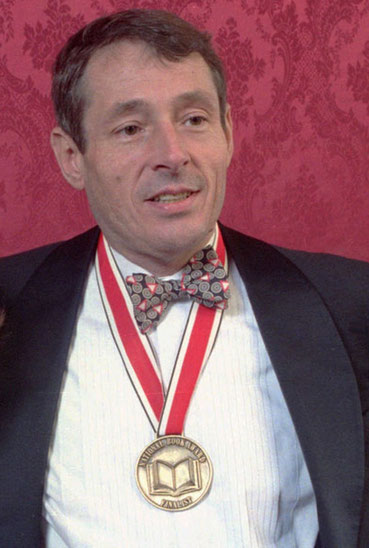
Paul Monette with his well-deserved National Book Award medal in 1992.
What is it?
A memoir by American writer Paul Monette, first published in 1992.
Why’s it subtitled "Half a Life Story"?
It could be because it’s the story of his life only until age 30, and he was 47 when the book was published, so it’s more or less half of his adult life to that point. But it also carries shades of “half-life” in the sense that his life until age 30 was lived largely in the closet, so it wasn’t really a full life.
So this is the story of his years in the closet?
That’s exactly what it is. It’s a memoir about how, as a child and adolescent and young man attracted to other boys/men, he tried so hard to hide this side of himself. What I found astonishing about this memoir is that it really is about ONE THING: hiding his homosexuality. There’s scarcely a paragraph in the book that doesn’t reference this closeted life in some way.
I didn’t really think there was that much to say about being closeted.
Well, turns out there is, in the hands of a master memoirist like Paul Monette. He recounts his childhood encounters with a tough boy named Kite, as they wrestled and played with each other. His little group of two oddball friends at his private school, meeting up in the cemetery to talk about everything except sex, all of them clearly queer yet none of them ever referencing the fact. His self-defeating crush on his depressive straight roommate at Yale. A devastating “affair” with a manipulative student at a private boys’ school that could easily have destroyed his professional life. His frantic attempts to learn how to be straight even as his girlfriends see the truth shining in front of them like a neon sign. This book is a forensic examination of Monette’s life in the closet until he meets his first true love at age thirty and finally accepts that being gay can be a source of joy and pride.
Is it ever a question of “too much information”?
Never. Monette needs to tell all to demonstrate just how corrosive sexual shame can be, over years and even decades. It sometimes makes for very uncomfortable reading, not because it’s “too much” but because it’s too close. I think almost any queer person will identify with many of the situations in this book, so beautifully pulled apart and examined by this powerful writer. Like this passage about using Art as an antidote to Sex: “I think I believed that Art would give me an entry into a no-man’s-land where the laws of straight no longer applied. And that once I touched the soul of another artist, a comrade in arms, the bodies would fall into place like the folds of a garment, twining us in a passion of the flesh. Pretty high-falutin’ stuff, and an awful lot of effort just to get a man to go to bed with you.” Ouch! This is all too close to the bone for me!! As I’m sure it will be for many others.
Does this still have anything to say to younger queer folks, growing up in 2026, in today’s open society?
I have no way of knowing how young queer people feel, but there are so many layers to Monette’s writing that I think much of it is universal and timeless. In the end, as he admits, he’s a romantic, “looking in the wrong places for the thing I’d never even seen: two men in love and laughing.” In the age of Grindr,
I get the impression that young gay men are still looking in the wrong places for something that maybe they don’t even realize they want: love. What could be more universal than that?
Stars?
Absolutely! Three!! This may just be the great gay memoir. I can’t say enough good about it. Learning to accept oneself as a queer person, and then learning to love oneself as a queer person, and then finding love—these are timeless, universal themes of queer life, thoughtfully examined here by a master writer who manages to make all this pain highly readable, occasionally funny, and even entertaining.
My sole reservation is that I wish Monette could be the tiniest bit less angry and a lot more compassionate towards his younger self. But writing this memoir seventeen years after finally finding love, and now being afflicted with AIDS, it’s understable the rage and regret he must have felt for the lost years, given how few years of healthy gay life he got to enjoy. But in the second-to-last paragraph of the book, he offers the reader respite and hope: “If the slightest thing had happened any differently in my checkered life, I wouldn’t have been there to meet Roger [his first love] that Sunday night on Revere Street.” Romantic to the last, Monette soars above the day-to-day and offers the solace that suffering has a meaning we cannot fathom in the moment. Love makes it all worthwhile.
Write a comment